

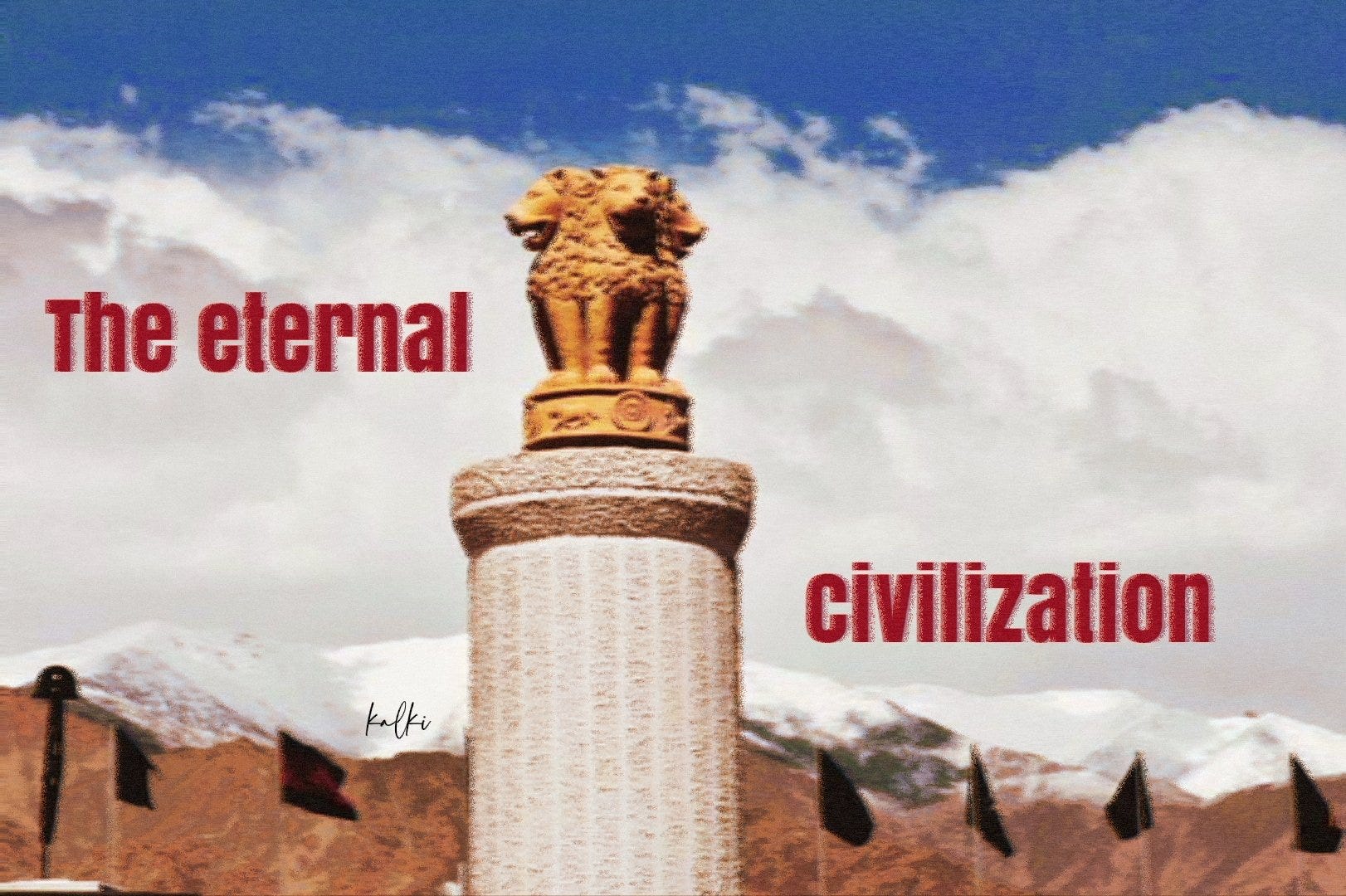
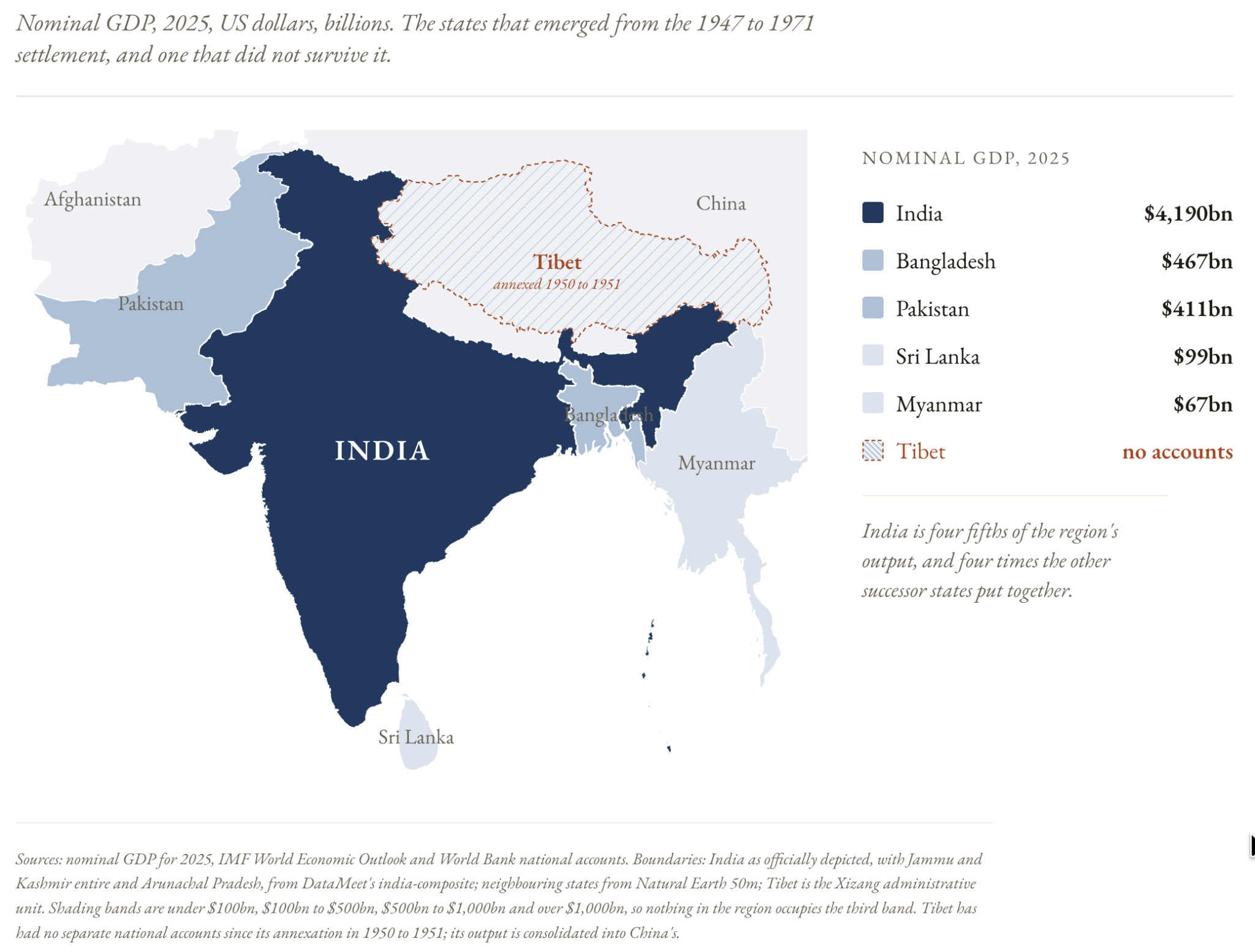
In the period of 1947 to 1951, multiple nation states were drawn out of the freedom struggle and Indians lost a good part of their landmass and people. The subcontinent did not enter a common future. Of the states born from the subcontinent’s fractured freedom, only the Republic of India has sustained the test of time for scale, continuity and ambition of a sovereign civilisational state. In all this we have this bright eyed republic which continues to prosper and grow in interesting ways especially after the liberalisation [1].
India now faces a new test of sovereignty. Nuclear weapons secured deterrence, energy powered industry and software gave its makers leverage over global commerce; AI carries that advantage into cognitive work, where the best systems already write complex code, advance unsolved mathematics [2] and design functional proteins [3]. The frontier is the moving edge of what the most capable systems can do. For India, sovereignty means being able to defend the republic and run its critical systems without a foreign state or company setting the terms. Whether it can preserve that freedom as intelligence becomes an input into science, industry and war is the question of this essay.
As we enter into the era of intelligence, we will see a disruption that will transform the economic and social fabric of India - we will see a drug development explosion like never before, new materials, new firms and most forms of current white collar work will be transformed. We expect a wider distribution of millionaires than ever before, and a new axis of power granted to nation states.
We cannot muddle through this like other technologies. Tariffs, scattered industrial subsidies and underpowered research programmes will not work anymore. Also, making lousy attempts to catch up to the frontier without the right ingredients will be a failure mode. The deeper danger is the sovereignty gap, the distance between the strategic freedom India expects to possess and the technological systems it can actually build, inspect and control. Closing it will require a grounded and pragmatic vision for renewing both national capability and civilisational self-belief.
The sovereignty gap is not the work of one government, one party or one historical mistake. It widened slowly, as generations of elites learned to route around broken institutions (more than fifty million court cases pending [4], a case can outlive the person who filed it!), rather than repair them, and our dysfunction became familiar enough to look permanent.
Seeing this clearly is not an act of despair. Better ideas are therefore not attacks on India. They are expressions of confidence in what India can become. The task is to recover the habit of thinking clearly about power, scarcity and national capability before we lose our degrees of freedom to affect it.
Holding the Line
There are few institutions in India on which we can have proven the test of time and we can always rely upon them and one of them would be the Indian Armed Forces. They reflect one of the best the state offers and flexes as capability. Intelligence is going to change this paradigm more than we imagine.
Look at the geography of Indian landmass and we share land borders with Pakistan and China to the north. That’s about 3,488 km with China (Tibet) border, and 3,323 km with Pakistan [5]. From western tip of Rajasthan to the eastern tip of Arunachal across the Tibetan plateau, every part is different and always changing.
Building upon that, just think of how the defense establishments are using these technologies. One example is the Maduro operation of January 2026, when the sitting president of Venezuela was taken alive by US forces. The Wall Street Journal reported that Anthropic models were used in the operation [6]. These models can hold on to information like terrain, weather, road, supply, the qualitative and the quantitative.
Every serious military already has wargames. Armies used to learn by fighting: doctrine, terrain sense, the thousand small things one only knows because soldiers were there, all of them pay for it and some even with the highest order of sacrifice. Simulation at scale totally changes the order. Armies learn about the war before they fight it. And once the harness is running on every parameter at once, systems are operating past what any general or staff can hold in his head. No one can beat maths. We need better systems and we need intelligence. Compound that over decades and fold them into the Chinese military prowess (US naval intelligence estimates Chinese shipyards hold more than 200 times America’s shipbuilding capacity [7]) and the picture changes entirely. Economic and industrial might, and above both a harness that has been trained on every wargame simulated or recorded.
Wargaming becomes a liability the moment the intelligence underneath it is not yours. Open weights help, though they do not by themselves make a system secure. Once a foreign-built model has been fed war plans, force positions and logistical weaknesses, every flaw in it or in the software wrapped around it opens a path to the state’s most sensitive holdings Forces are simulating their own defence inside an artifact they did not build and cannot audit. And the first security imperative for the Indian state is to defend the land we already have.
Middle Power is a losing premise
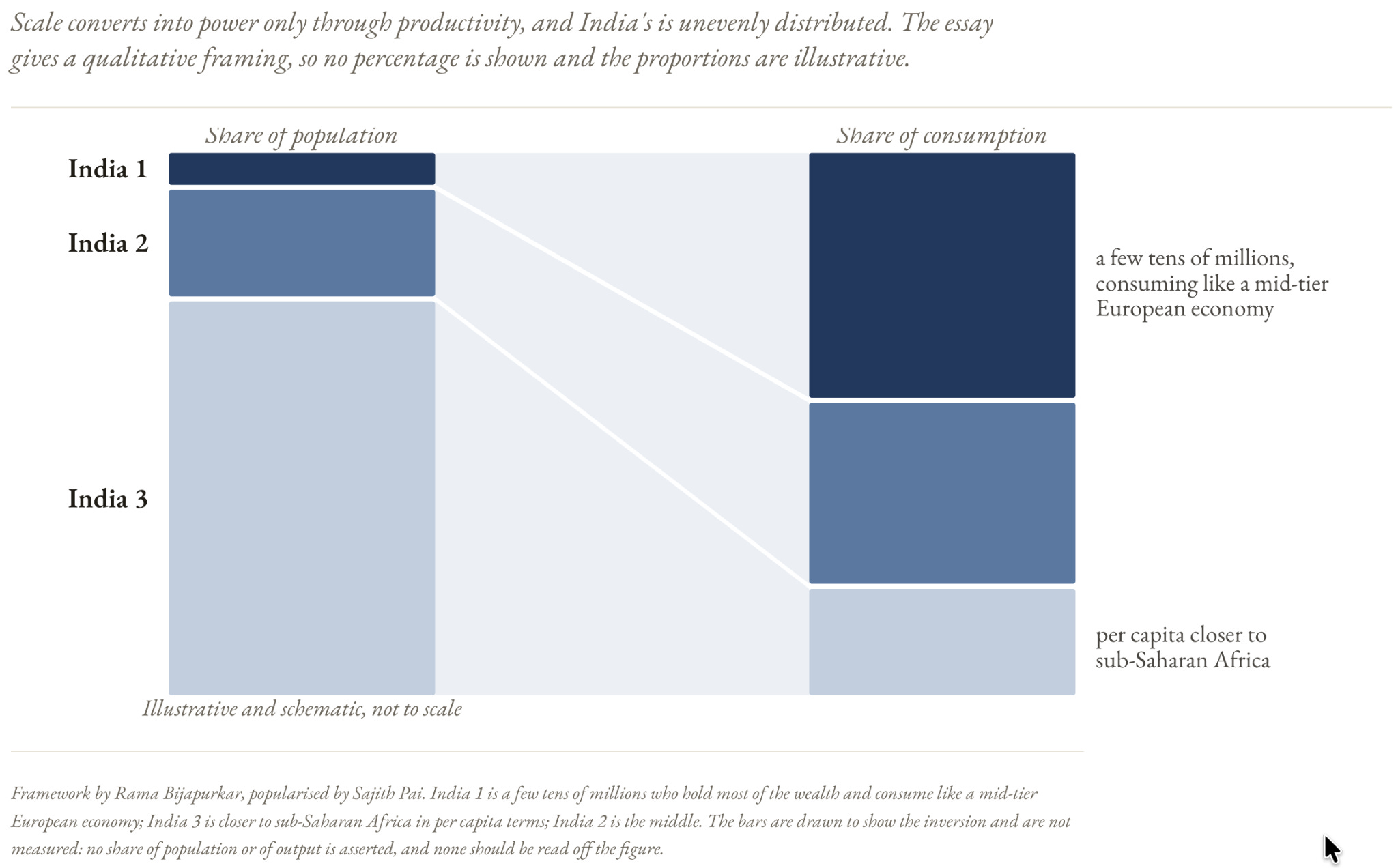
Socio-economic apparatus in India is unevenly distributed into 3 segments. Popularly known as India 1, India 2 and India 3 [8]. India 1 is the size of a mid-tier European economy and consumes like one. India 3 is sub-Saharan Africa in per capita terms. Governments cannot run a great power foreign policy on the output of your top decile while carrying the other ninety percent as a fiscal obligation.
Two things are on the table. We are useful to the Americans against China, and we are a large market. Confusing it for something lucrative is naive.
Being a counterweight is a weak position. It lasts as long as Washington fears Beijing. And the market argument is worse, and it is the one Indian commentary gets wrong most often. A large market is leverage that others exercise on us. It makes us a customer, and customers get courted and then squeezed, because the relationship runs one way: they have something we want to buy. Market access is a chip that gets played once per negotiation and never accumulates into standing.
Middle power is not a size category. It is a bargain: a ceiling on autonomy in exchange for security under somebody else’s umbrella, which frees the state to specialise economically. Japan took that bargain in 1945 and it worked, which is why Japan is a poor example of a middle power rather than a good one. A top-tier economy that outsourced its security and is now trying to buy it back, late and struggling. South Korea and Australia took the same deal more openly.
So middle power is a losing premise, and not because it is an insult. Because it asks us to accept a ceiling, and refusing that ceiling is the one thing our history has been consistently about.
India should not take it. But refusal has a price. The state has to generate its own security, its own deterrence, its own industrial base, and it cannot decline the umbrella and then plan as though it were standing under one. That is the incoherence in Indian strategic thought right now: middle power economics, great power ambition, and nothing in between.
Coming back to today
Frontier AI capability is produced by a scaling complex of compute, energy, capital, and concentrated research talent, which is scarce and cornerable [9]. Run an audit on India’s tech stack today and the first conclusion we realize is that India has some of each, but they remain scarce, fragmented, and difficult to assemble into frontier capability.
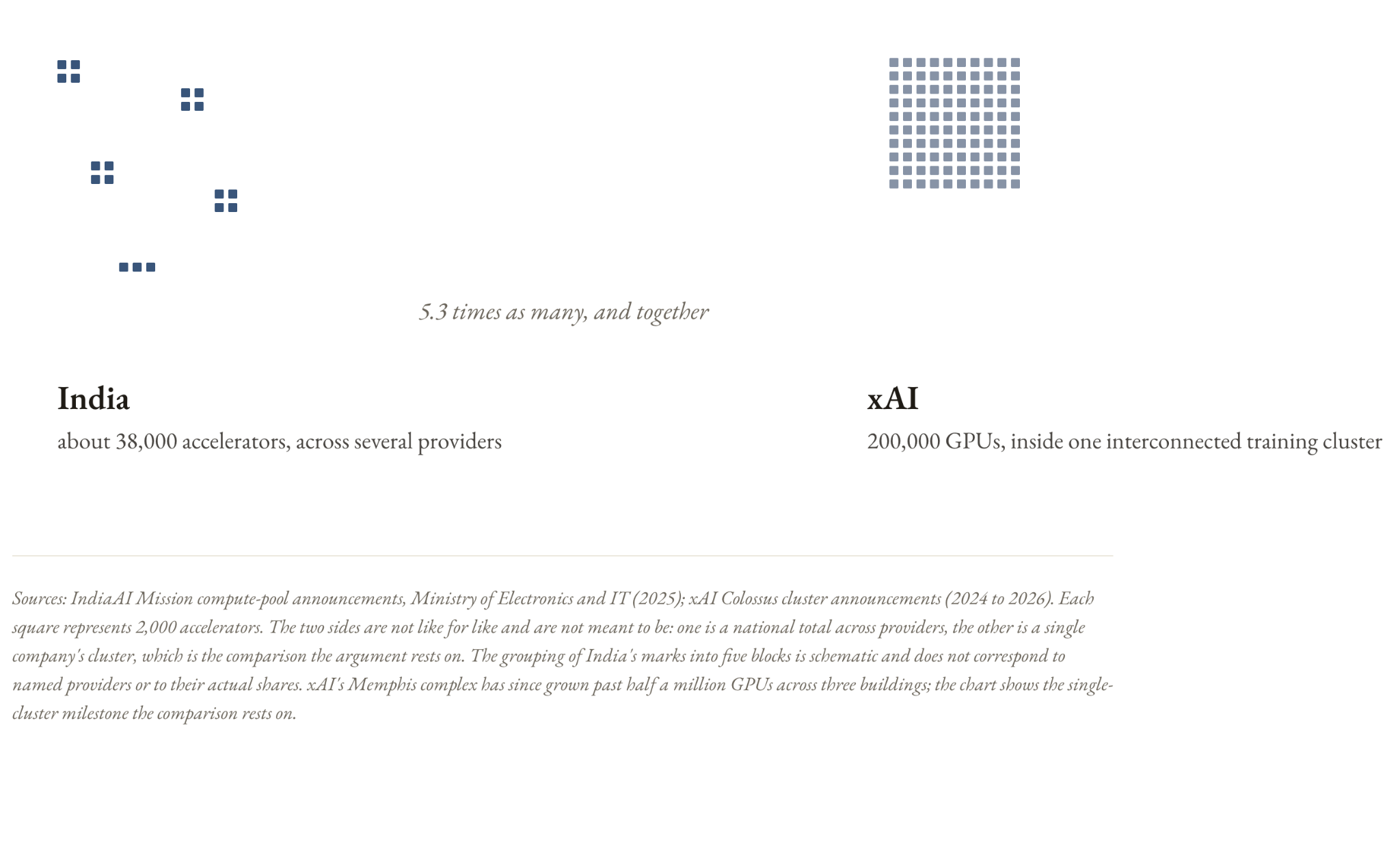
For some numerical anchor points, India has about 38,000 GPUs empanelled across several providers under the IndiaAI Mission’s common compute pool [10], while xAI (one of the major AI labs) assembled 200,000 GPUs inside a single interconnected training cluster in under a year and has since grown its Memphis complex past half a million [11]. The difference is not the number of chips, but the ability to operate them together, keep them supplied with power and repeatedly run frontier-scale experiments. The capital asymmetry gap is even starker.
Alphabet expects to spend about $200 billion in 2026, with roughly 60% going to servers and 40% to data centres and networking, much of it for AI [12]. That is more than thirty times India’s projected annual AI spending, which IDC puts at about $6 billion by 2027 [13].
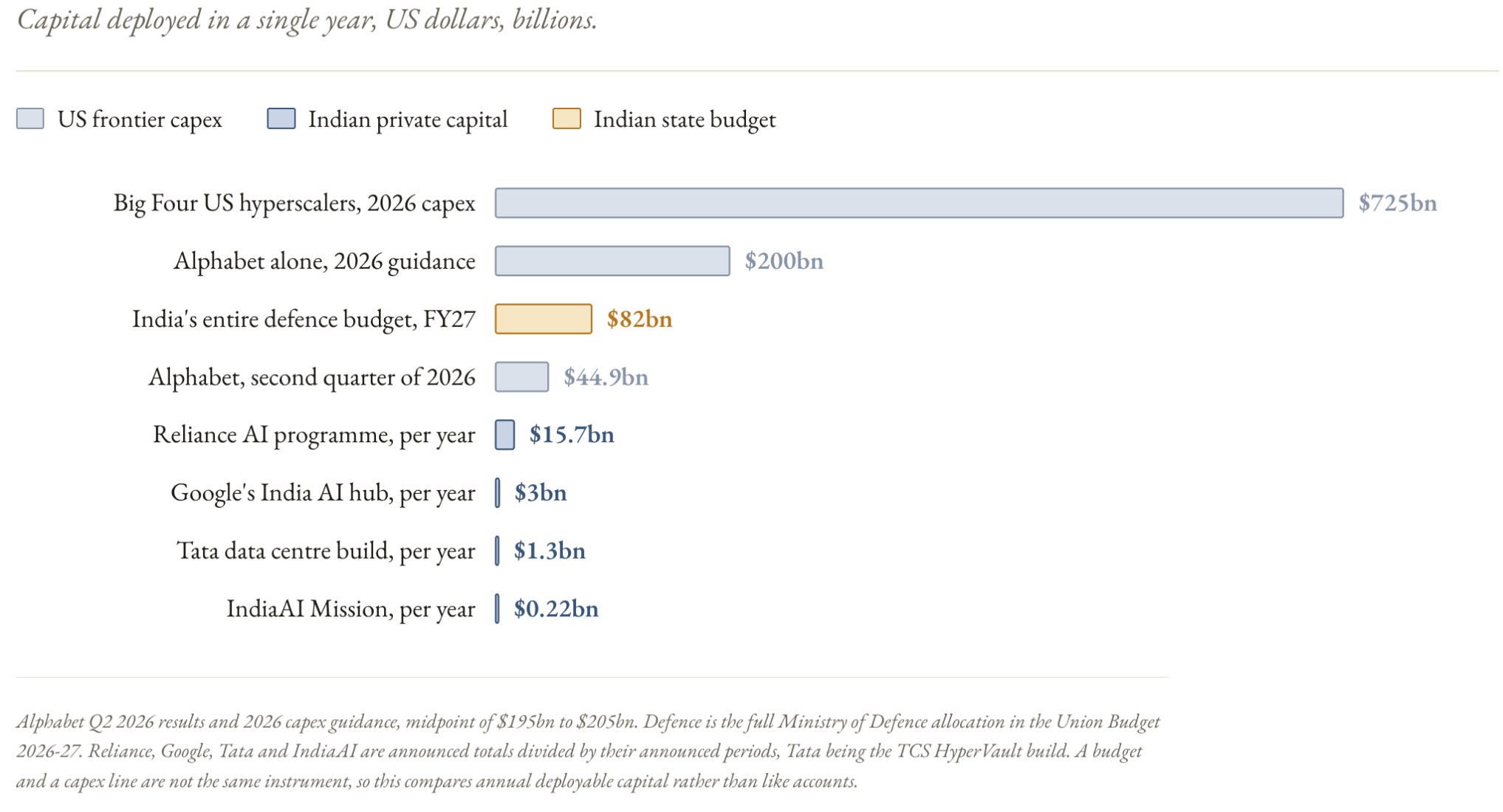
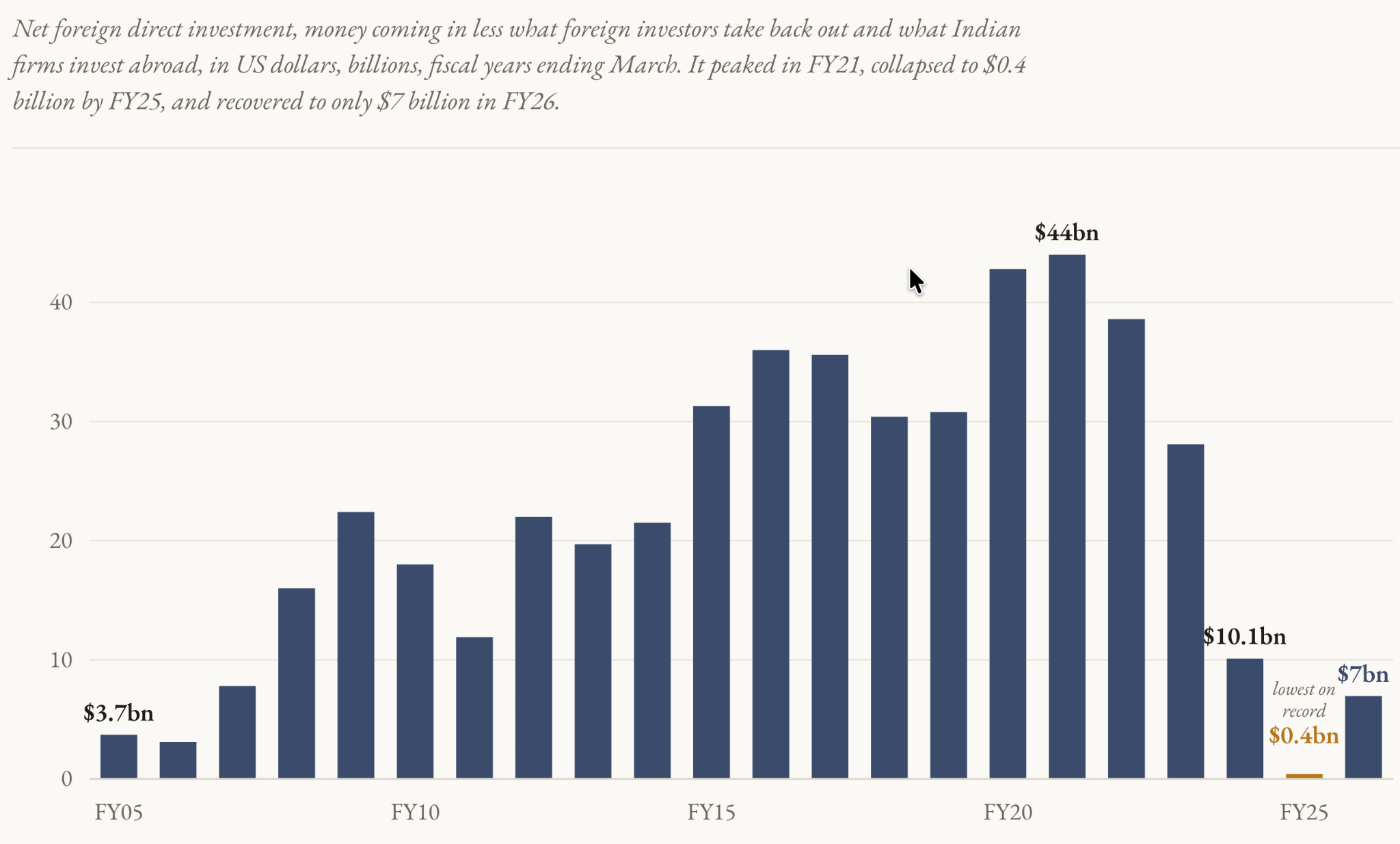
India earns substantial foreign exchange from software and other service exports, supplemented by rising remittances from Indians abroad. These inflows finance much of its persistent trade deficit and keep the current-account shortfall manageable. But they do not, by themselves, build the factories, infrastructure, intellectual property and technology firms needed to reduce India’s dependence on future imports [14].
These earnings are more readily used to pay for consumption and imports than converted into productive assets that generate income at home. The question is not simply whether India earns enough abroad to buy advanced technology, but whether it can turn those earnings into domestic capabilities that reduce future imports and create new exports.
Still, a clear-eyed view of India’s AI story reveals progress is on the way. Noticeably, Reliance has committed roughly $110 billion over seven years to AI infrastructure and is building gigawatt-scale capacity at Jamnagar [16]. Neysa, an AI inference company, secured a Blackstone-led financing package of up to $1.2 billion to deploy more than 20,000 GPUs in India [17]. Sarvam, another unicorn, develops models for Indian languages, coding, cybersecurity and sovereign deployments [18]. The IndiaAI pool gives startups and researchers subsidized access to compute [10]. Tata Electronics’ fab at Dholera and the HCL-Foxconn venture also move India further into chip manufacturing [19][20]. Together, these efforts put more hardware on the ground and give Indian companies and engineers experience building and running large AI systems.
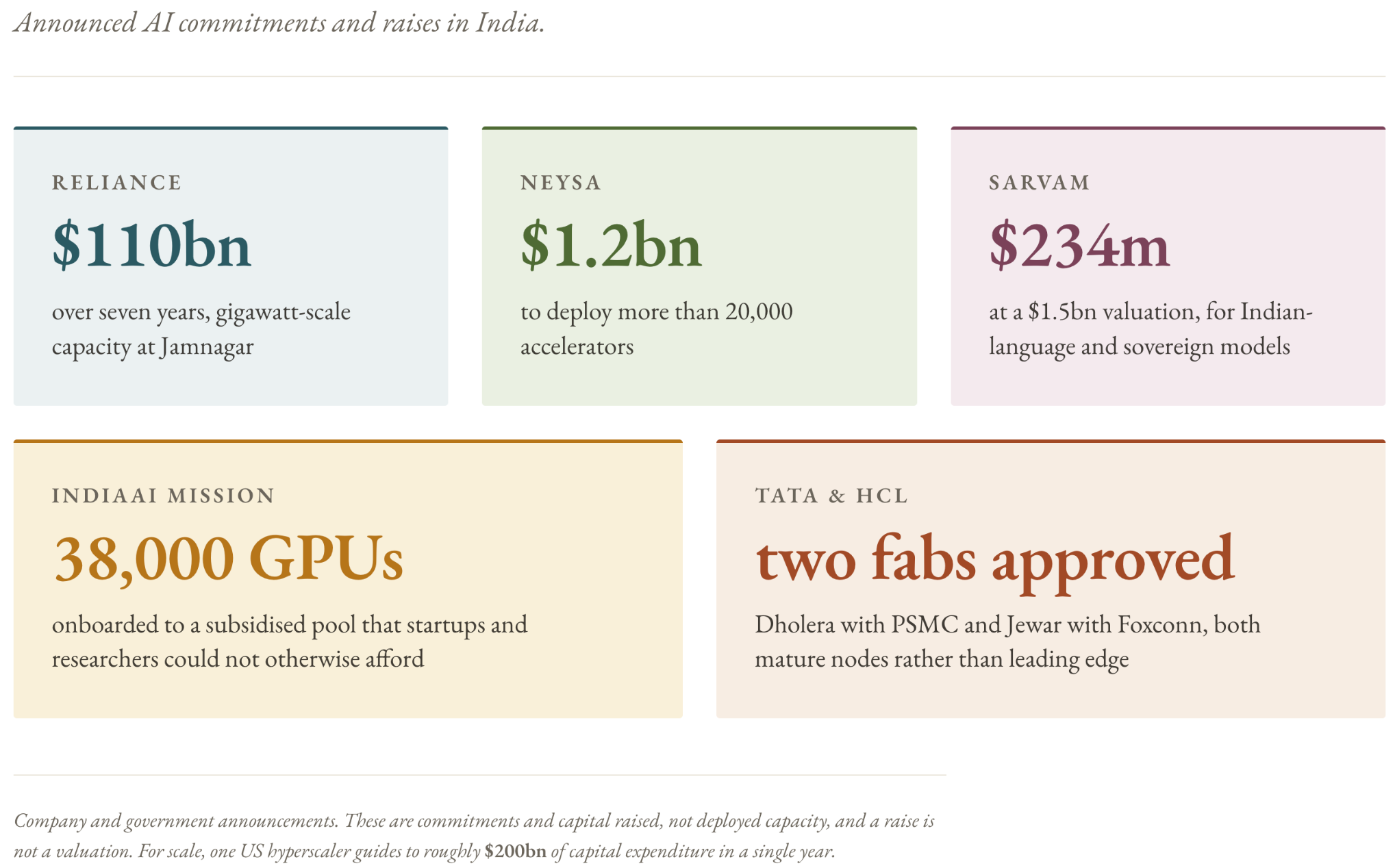
These investments matter, but they are not the same as operating at the frontier of AI capabilities. A data centre in India still depends on foreign chips, networks, model architectures, and research. Meanwhile, the few labs at the frontier in the United States and China turn each training run into better models, more users, more revenue, and more talent for the next. India can improve its absolute capabilities while still losing relative ground to competitors whose advantages compound faster.
What doing good looks like
A gap of this size usually invites a national mission, a large budget, and a grand production target but India’s own history argues for something different. In 1991, India held foreign reserves sufficient for barely two weeks of imports. Manmohan Singh, then finance minister, led the dismantling of industrial licensing, devalued the rupee, lowered trade barriers, and opened large parts of the economy to competition [21].
India’s underlying endowment did not change that summer. What changed was their allocation - Capital could move into more productive firms; manufacturers could import machinery and reach foreign markets; service companies could expand; and entrepreneurs no longer needed the state’s permission for every act of production. Those changes compounded into much of India’s modern economy.
The reforms of 1991 opened India’s markets. The next economic freedom movement must reach the markets for factors of production, especially land, power and capital, which will determine the AI build-out and deployment. As AI substitutes for a larger share of routine cognitive labour, the returns to service-sector skills that poorer countries spend decades accumulating will fall. Access to energy and capital, and the ability to combine them productively, will matter more.
Capital is more fluid than people. It goes where power is cheap, land is available, contracts hold, justice is granted and policy is predictable. India may not build the world’s best frontier model anytime soon. But it can become one of the best places to deploy those models at scale - and capture the downstream value, build the firms, infrastructure, and exports around it.
India should begin by making deployment easy for users and companies alike. A gigawatt-scale data centre is a decades-long wager on its host country, and regulatory instability, slow courts and unreliable power raise the friction of such wagers. India can lower it by accelerating permits for data centres and grid plans, making taxation predictable, easing exchange controls and enforcing contracts to enforce long-term land leases, power-purchase agreements and supplier contracts.It must also repair the power system on which deployment depends, especially transmission, distribution and industrial electricity pricing.
India must also invest in manufacturing. In 1973, Taiwan, then far poorer than India is today, created the Industrial Technology Research Institute as an applied-research institute. Three years later, it committed $10 million to a semiconductor programme built around licensing Radio Corporation of America’s (RCA) chip technology and embedding 19 Taiwanese engineers in its American plants for a year. The demonstration line they set up reached a 70 per cent yield within six months of starting up, compared with 50 per cent at RCA’s own plant [22][23].
India’s iPhone manufacturing boom follows a similar trajectory. Apple now assembles about a quarter of its iPhones in India and exported more than $20 billion worth in the last fiscal year [24][25]. Beyond the export revenue, the compounding asset is the stock of human and organisational capital accumulated along the way, with hundreds of thousands of workers and managers learning how a state-of-the-art manufacturing system actually runs.
India should then compete where advanced capability remains open and where it already has the primitives for scale. Open-source models such as Inkling, Kimi, and DeepSeek hand near-frontier capability to anyone with the compute and skill to run them, and their champions now include most of the American industry itself, defending open models as the substrate on which the most of the world will run AI on [26].
Open source does for India what the RCA licence did for Taiwan, converting a research problem we cannot yet win into an operations problem we can. Serving models is a business of cheap power, low latency and disciplined operations, not massive GPU training runs. For example, a neocloud that hosts open models for Indian firms, and runs the state’s work in government, courts, defence and health on machines inside the republic and under its law, makes money and also narrows the sovereignty gap at the same time.
Serving open models at scale is only the base layer. Paired with high-risk, high-reward capital and coordinated research programmes modelled on India’s nuclear and space efforts, but adapted to a free-market economy, could help India leapfrog to the state of the art in chosen domains and build the translation layer that turns models into approved therapies, new batteries and grid-control systems.
Medicine is a natural starting point. India supplies around 20% of the world’s generic medicines by volume, largely through mastery of manufacturing processes rather than molecule discovery [27]. As AI shifts the bottleneck toward designing, testing, and manufacturing treatments, India can combine national compute, lab automation, and its contract-research base. For example, Tuberculosis, for which India accounts for about a quarter of global cases, offers an urgent proving ground for better diagnostics, vaccines and drugs [28]. Success would not only meet a vast domestic need; it would build a pipeline for producing novel treatments cheaply enough to use at home and export abroad.
Energy offers another opportunity. Energy offers a second opening. India has contracted some of the world’s cheapest new solar power. The challenge is to deliver that power reliably at industrial scale, which requires better storage, transmission and distribution. AI can improve demand forecasts and grid dispatch, and accelerate the discovery of better battery chemistries and advanced conductors. Solving these constraints would lower the operating cost of every data centre and AI-enabled factory in India. Better storage and transmission bring the old promise of energy too cheap to meter closer to reality and could convert cheap solar into abundant compute [29].
Imported Fragility
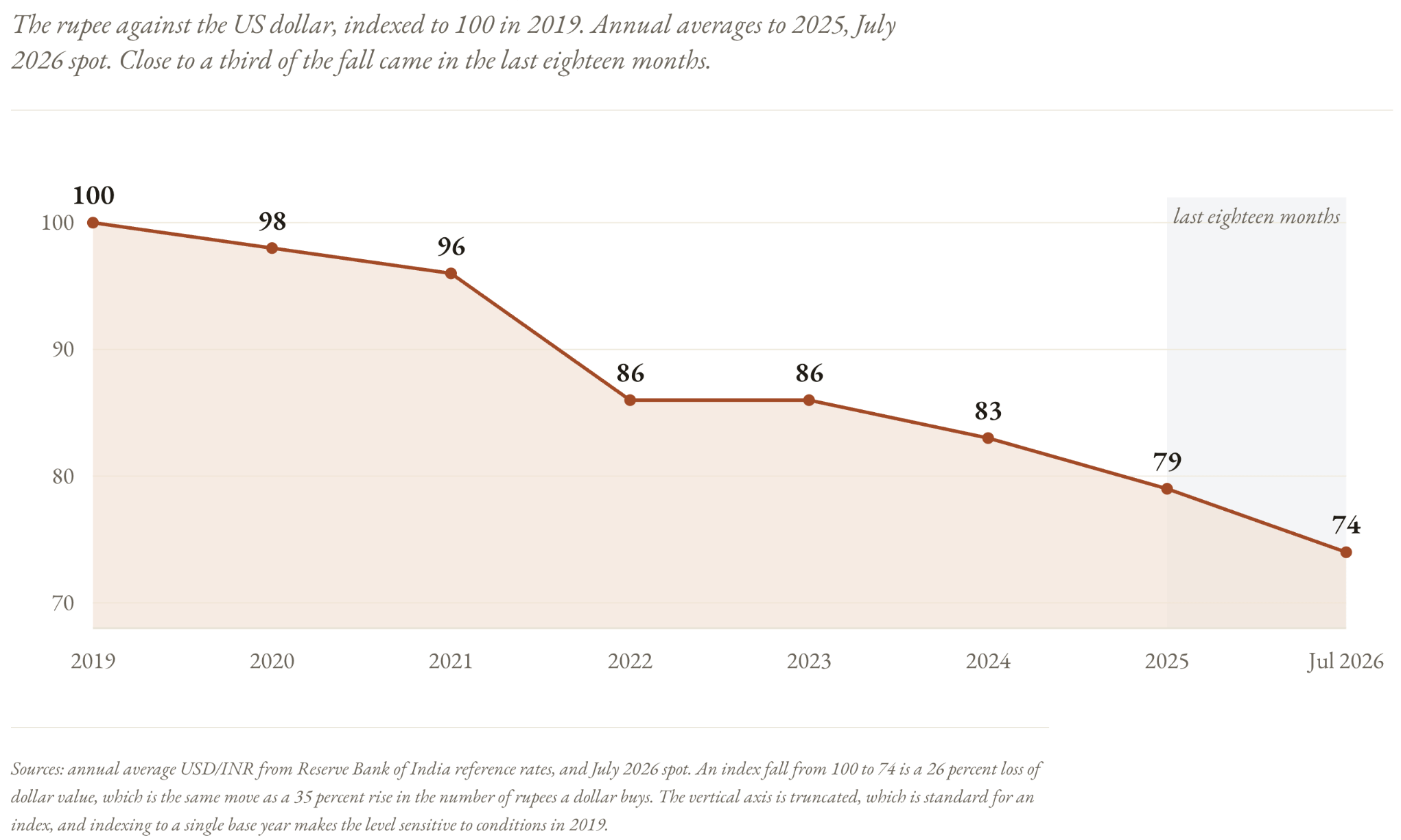
India enters this age of intelligence already exposed. It imports most of its oil [30], buys much of its advanced military hardware abroad [31], and relies on a $315 billion technology sector for exports and white-collar employment [32]. The rupee has lost more than a quarter of its dollar value since 2019 [33], making every imported chip, model licence and barrel of oil more expensive in Indian terms. AI creates a new import bill for chips, models, and machine intelligence while reducing the value of routine cognitive work. The revenue that once flowed to Indian IT firms are beginning to move upstream to the companies that own the models, as the junior work on which India trained generations of engineers is among the first to be automated [34].
The obvious political response will be to protect jobs by slowing adoption. That would preserve some tasks while destroying the firms that perform them. Foreign customers will not keep buying expensive human labour because Indian regulation requires it. Occupational restrictions, hiring mandates, and liability rules that discriminate against automation would make Indian firms slower at a moment their competitors are becoming faster. The state should protect people with flexible support and rapid retraining, not protect production methods that the rest of the world has abandoned.
India runs on Aadhaar, UPI and the power grid all of which sit on top of chips, firmware and software that India neither built nor fully inspects, and they are defended by human analysts while cyber offence now moves at machine speed. Exposure to bio threats is worse. The last pre-AI pandemic killed Indians that credible mortality estimates put in the millions [35], and AI lowers the floor for engineered biology everywhere while raising the ceiling for defence only in the countries that build the defensive stack. Both risks lead to the same conclusion. For the functions the state cannot afford to lose, India needs models it can inspect, running on hardware it controls, under its own regulation and distributed by its markets.
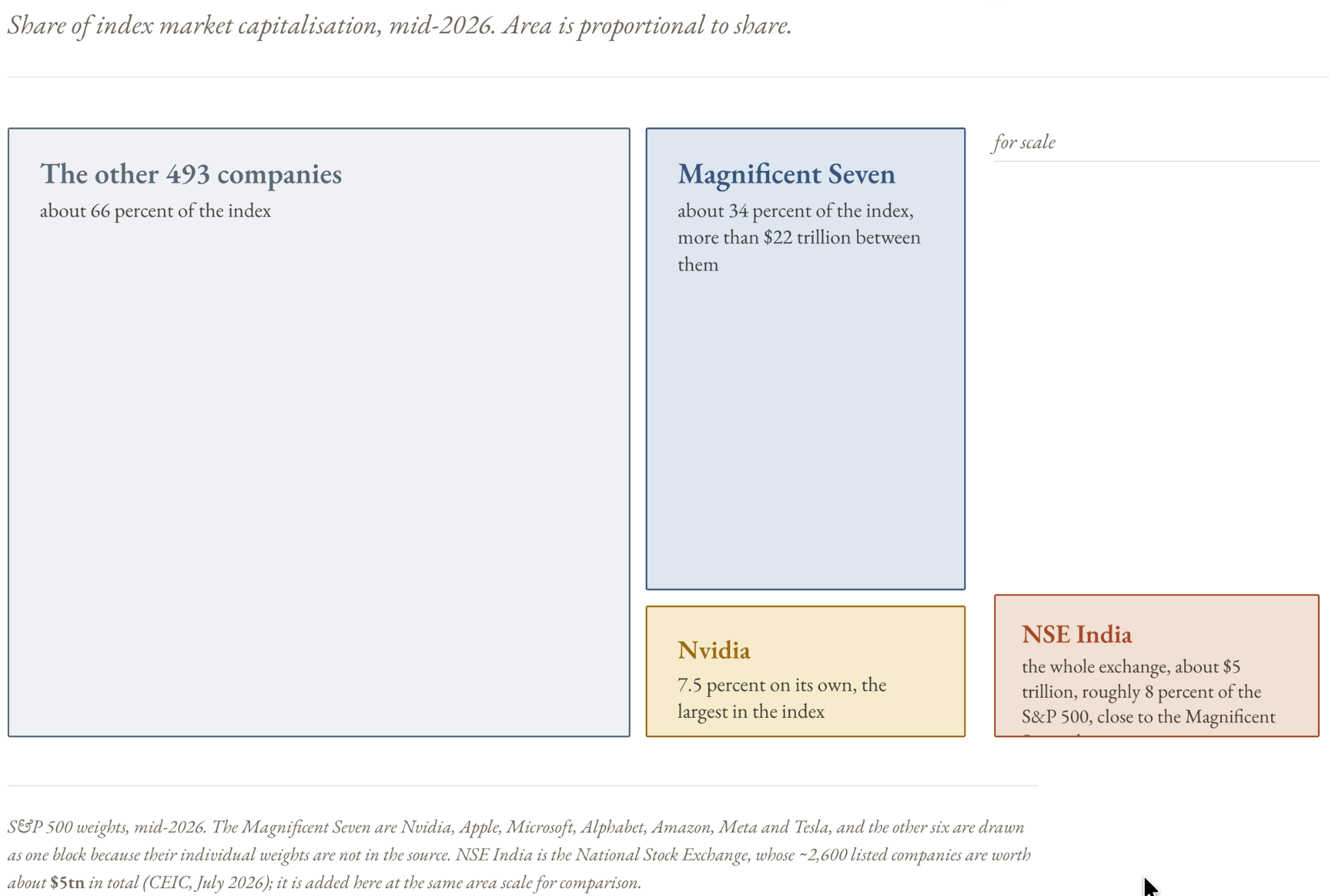
And look at where the value is going. The American stock market has quietly reorganised itself around a handful of companies whose worth now rests on the AI build-out. Seven of them are about a third of the entire S&P 500, the most concentrated the index has been in modern history, and Nvidia alone is now worth more than $5 trillion [36][37]. Being the best in the world and compounding matters!
Winning is the only option
India should compare itself with the countries setting the frontier, not with countries falling behind more slowly. The United States and China are the only two systems competing across models, chips, compute, capital, and deployment at the relevant scale. They will set the price of intelligence and, increasingly, the balance of power.
Winning does not mean reproducing the American stack or leading every benchmark. It means starting with owning at least one compounding frontier and retaining control over every system essential to national sovereignty and security.
For the Republic of India and its citizens, there is no option but to win at the state of the art. We need to lock in. Time and Agency have never been more critical to our republic’s survival and vitality.
Where’s Homi?
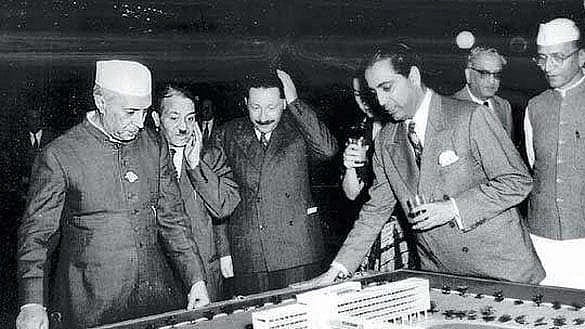
In 1962 the Chinese did a number on us, and the rest of the country learned what Bhabha had foreseen. Two years later, when China tested at Lop Nur, Dr. Homi Bhabha, one of our greatest scientific pioneers, went on air within days and talked about nuclear deterrence, about the capability of tangible damage. A country that can be hurt without the ability to hurt back is not conducting foreign policy, it is requesting it [38].
He did not pretend the scarcity away, and he did not copy the American playbook, which was written for a uranium-rich country. India held little uranium but a quarter of the world’s thorium, so Bhabha designed a three-stage programme around this asymmetry. The small uranium stock would fuel the first generation of reactors, those reactors would breed the fuel for the next, and the final stage would run on thorium, the one input India had in abundance [39]. Each stage was designed to make the scarce input matter less.
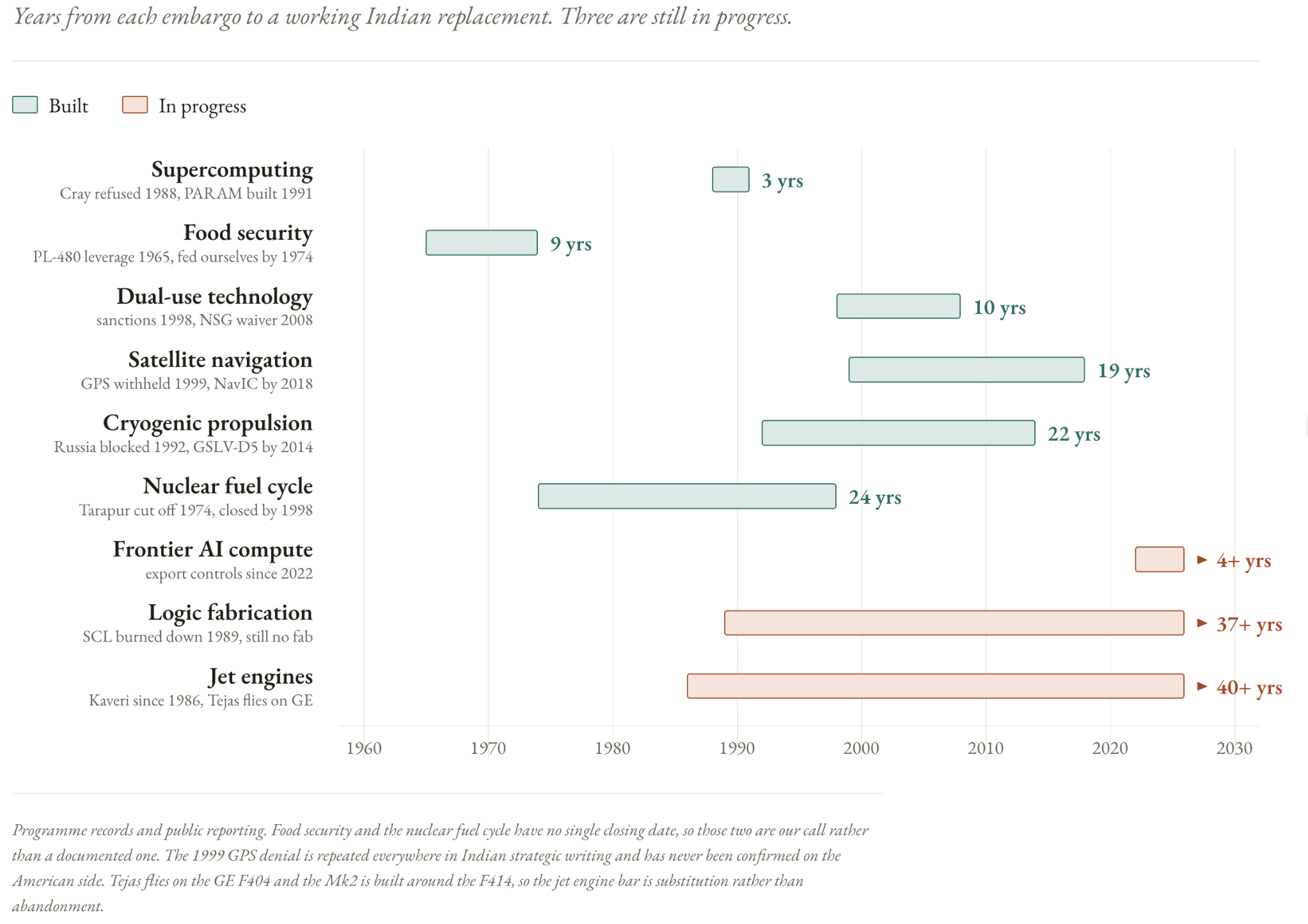
That clarity, held early and held against fashionable opinion, is a large part of why India stands where it stands. The nuclear tests of 1974 and 1998, the space programme, the missile programme, all of it flowed downstream of a small number of courageous voices who spoke before it was safe to speak, and kept fighting until we built national consensus on this reality.
As for nukes, we had Dr. Homi Bhabha and a series of people intolerant of excuses. But, for AI?
Indian Exceptionalism
A word to the reader about why we wrote this, because the preceding pages have been a bit unsparing and difficult to apprehend for us as well.
We are long India. Not as a position but as a fact about ourselves. Love has its reasons that reason does not know, and we feel something for this land that we cannot fully defend on the evidence and do not intend to try. What we can defend is the observation underneath it - give Indians a genuine opportunity and a fair mechanism, and they outperform. We have watched it happen too many times in too many unrelated domains to treat it as coincidence.
Late last year, I (Achyut) asked Tyler Cowen why he backs India and its talent. For once, a man who has given the internet with great ideas on so many illegible problems could not concretely put down what drew him to the country. Betting on Indians is easy, however betting on the republic of India might raise some eyebrows. I relate the difficulty, having never found a coherent argument to be long India.
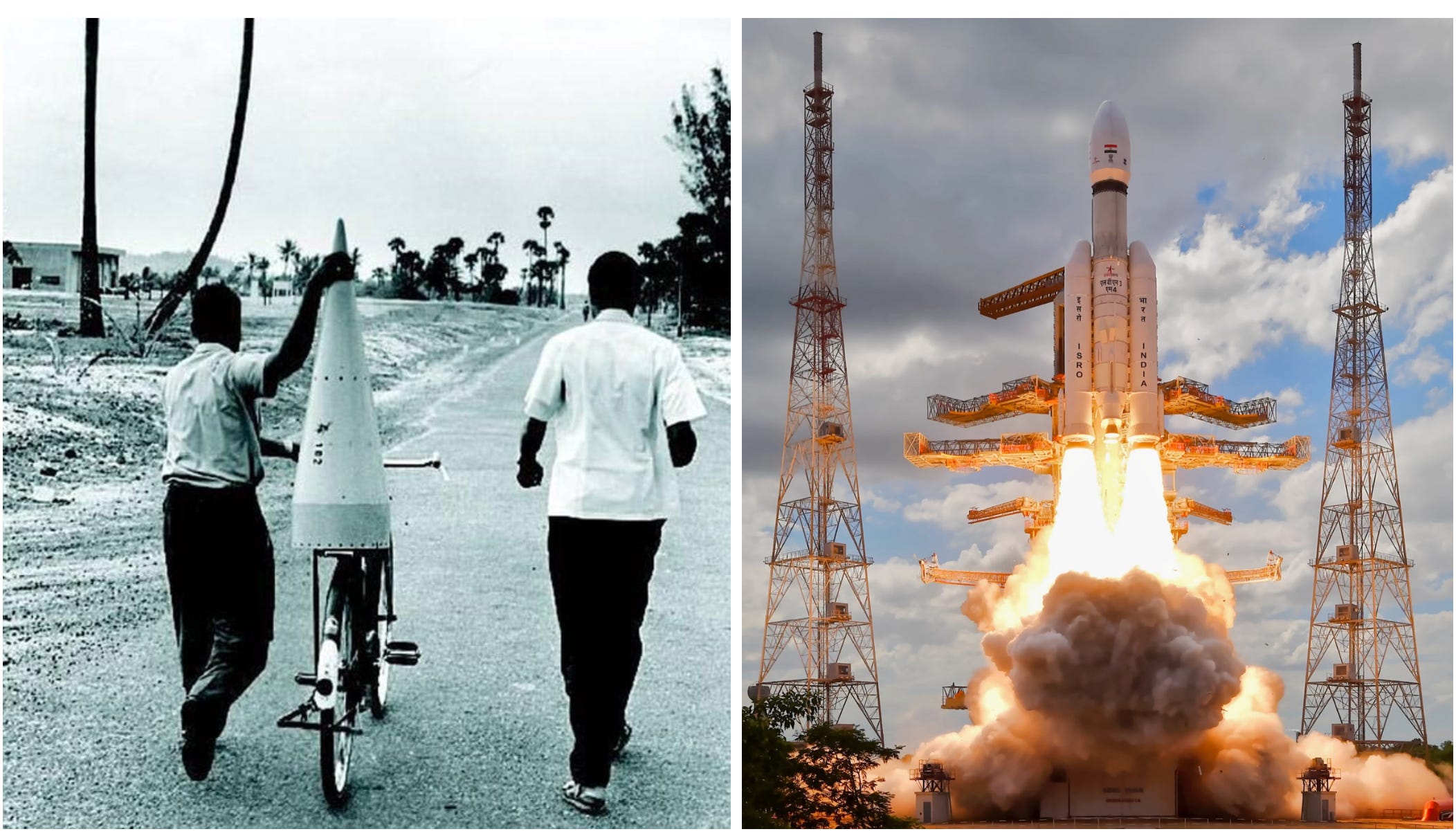
Joan Robinson comments [40], “ whatever you can rightly say about India, the opposite is also true.” We can reach the Moon and we cannot build a footpath that survives one monsoon. We have redrawn the map of a neighbouring country and we cannot reliably supply water to our own cities. India disappoints optimists and pessimists with equal reliability, and both camps are correct on the days they happen to be looking.
We believe there is a thing called Indian exceptionalism, and it needs deliberate activation to turn scattered talent and resources into robust national might. Not that India will be fine, and not that India is doomed, but that the conditions are set deliberately or they are set by default, and default is often not kind to anyone.
Satyameva Jayate is not a slogan about being right. It is an instruction to look. So we have looked at the numbers as they are, not as we would like them. We measure against the state of the art and against world scale, because those are the only benchmarks that will be applied to us regardless of whether we accept them.
We do not compare ourselves to countries falling behind more slowly, and we take no comfort from that ranking. When others lose, we do purva paksha - we study the losing position on its own terms until we can state it better than its holders can, and only then do we say why it failed. When we are the ones losing, we owe ourselves exactly the same treatment. Better ideas are our friends. Comfortable ones are not.
Acknowledgement
We would like to thank Shiv Kunal Verma, Naveen Benny, Priyank Chauhan, Pradyumna Prasad, Anagha for reading drafts of this.
About the Authors
Aakarsh Bengani studied at UC Berkeley and works at Renaissance Philanthropy to fund coordinated research programs in AI, biology, energy, materials, and other frontier technologies. Previously, he worked on AI Security, and is based in San Francisco.
Achyut Tiwari is the founder of GeoLiquefy, which builds probabilistic models of earthquake hazard, and curates IndianExceptionalism.org. He is an Emergent Ventures fellow and splits his time between San Francisco and Bengaluru.
References
[1] https://the1991project.com/documents/budget-speech
[3] https://deepmind.google/blog/alphaproteo-generates-novel-proteins-for-biology-and-health-research/
[4] https://www.newsonair.gov.in/over-5-19-cr-cases-pending-in-indian-courts-govt-implements-fast-track-courts-to-address-backlog Law Ministry reply to the Rajya Sabha; live count at njdg.ecourts.gov.in.
[5] https://www.mha.gov.in/en/divisionofmha/border-management-i-division
[6] https://www.france24.com/en/tv-shows/tech-24/20260215-anthropic-s-claude-helped-pentagon-raid-caracas-and-seize-maduro-us-media On the Wall Street Journal’s February 2026 report.
[7] https://www.twz.com/alarming-navy-intel-slide-warns-of-chinas-200-times-greater-shipbuilding-capacity Office of Naval Intelligence estimate, roughly 232x.
[8] https://blume.vc/reports/indus-valley-annual-report-2025
[10] https://www.pib.gov.in/PressReleasePage.aspx?PRID=2245069®=3&lang=1 Lok Sabha reply, March 2026; a further 20,000 GPUs were announced in February 2026.
[11] https://introl.com/blog/xai-colossus-2-gigawatt-expansion-555k-gpus-january-2026
[12] https://www.cnbc.com/2026/07/22/google-earnings-q2-goog-live-updates.html Guidance raised to $195-205 billion on July 22, 2026.
[13] https://www.idc.com/resource-center/blog/reimagining-industries-unleashing-the-power-of-ai-in-india/
[14] https://blogs.worldbank.org/en/peoplemove/in-2024--remittance-flows-to-low--and-middle-income-countries-ar India received an estimated $129 billion in remittances in 2024, the world’s largest.
[15] https://www.outlookbusiness.com/news/govt-says-net-fdi-decline-in-recent-years-due-to-increased-repatriation-by-foreign-investors RBI data via a government reply to the Rajya Sabha, July 2026.
[18] https://www.sarvam.ai/announcing-series-b
[21] https://www.indiabudget.gov.in/doc/bspeech/bs199192.pdf Manmohan Singh’s budget speech, July 24, 1991.
[22] https://itritoday.itri.org/114/content/en/unit_01-2.html ITRI’s own account of the RCA transfer.
[23] https://asteriskmag.com/issues/13/the-institute-behind-taiwan-s-chip-dominance
[24] https://techwireasia.com/2026/03/apple-iphone-production-india-25-percent-global-output/
[26] https://thinkingmachines.ai/news/introducing-inkling/
[27] https://www.investindia.gov.in/sector/pharmaceuticals
[28] https://www.who.int/teams/global-programme-on-tuberculosis-and-lung-health/tb-reports/global-tuberculosis-report-2025 India accounted for about 26% of incident cases in 2024.
[31] https://www.sipri.org/sites/default/files/2025-03/fs_2503_at_2024_0.pdf SIPRI: India was the world’s second-largest arms importer, 2020-24.
[32] https://nasscom.in/knowledge-center/publications/technology-sector-india-strategic-review-2026
[33] https://fred.stlouisfed.org/series/DEXINUS About 69.6 per dollar in early January 2019 against about 95 in August 2026.
[35] https://www.who.int/news/item/05-05-2022-14.9-million-excess-deaths-were-associated-with-the-covid-19-pandemic-in-2020-and-2021 WHO puts India’s 2020-21 excess deaths at about 4.7 million; the government disputes the estimate.
[36] https://www.forbes.com/sites/investor-hub/article/sp-500-weight-mag-7-stocks-diversification-risk/
[37] https://stockanalysis.com/stocks/nvda/market-cap/
[38] https://m.thewire.in/article/books/homi-bhabha-jawaharlal-nehru-and-the-bomb Bhabha’s All India Radio address of October 24, 1964, quoted in Dadabhoy’s biography.
[39] https://en.wikipedia.org/wiki/India%27s_three-stage_nuclear_power_programme
[40] https://en.wikiquote.org/wiki/Joan_Robinson As recounted by Amartya Sen, The Economist, November 18, 2005.
